
Bitcoin Spot vs. Bitcoin Futures Trading: Different Ways to Trade Bitcoin

CONTRIBUTED POST
NOTE: The references in this article are provided for informational purposes only. Always seek professional financial or legal advice before making trading / investment related decisions.
Bitcoin spot trading acquires BTC itself rather than a derivative, while Bitcoin futures trading creates price exposure through a contract linked to Bitcoin.
With spot, custody depends on where BTC is held: a centralized exchange controls the private keys for assets kept on its platform, while direct on-chain control requires withdrawal to a self-custody wallet.
Futures make shorting, hedging, and leverage easier, but add margin, liquidation, funding or basis, and sometimes expiration risks.
Key Takeaways
Spot acquires the underlying BTC, but buying on a centralized exchange does not automatically give the trader control of its private keys.
Futures provide contractual Bitcoin price exposure and usually do not involve receiving BTC.
Dated futures and perpetual futures differ in expiration, settlement, and funding mechanics.
Leverage can improve capital efficiency but magnifies losses and can create liquidation risk.
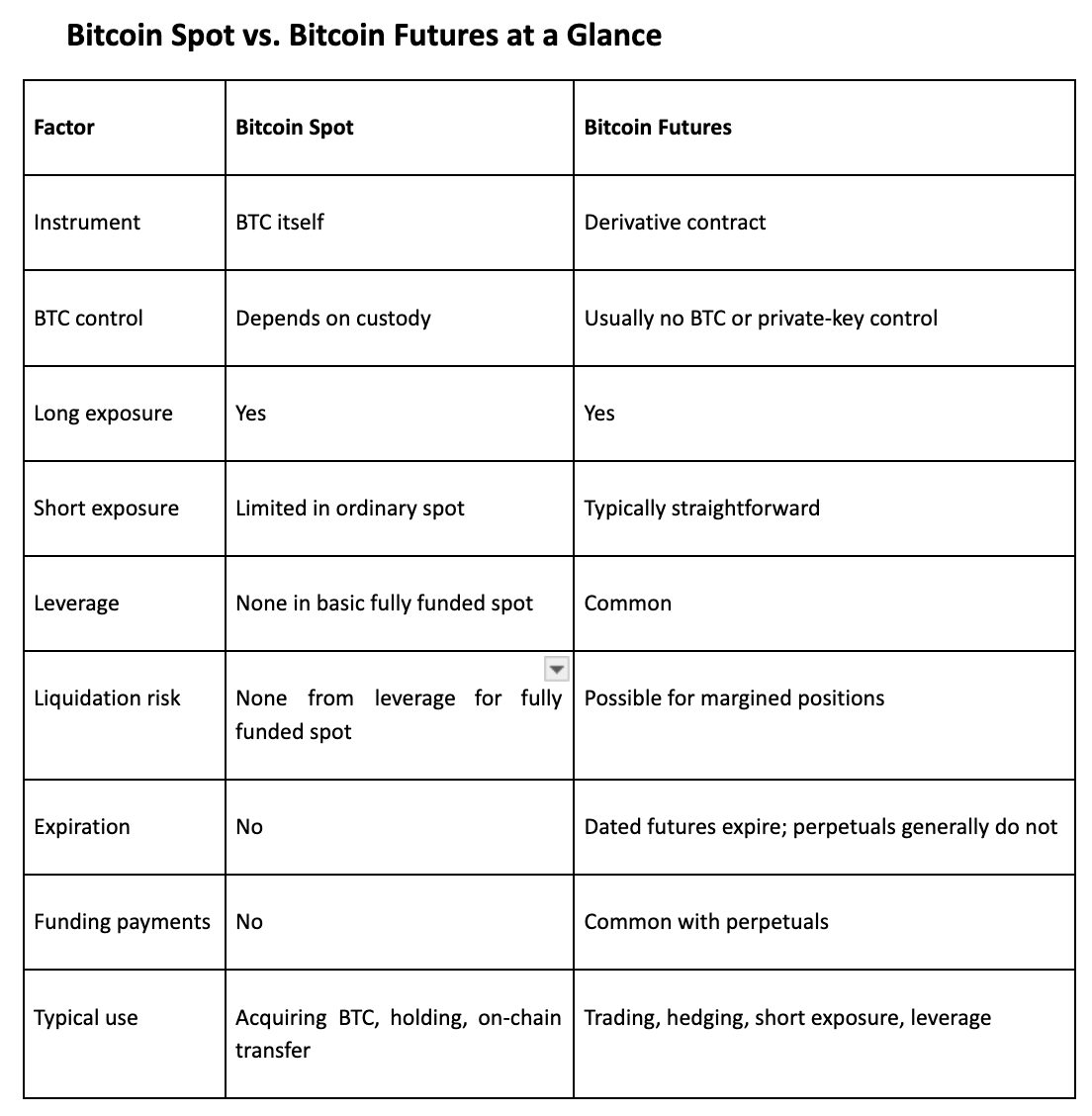
Some exchanges also offer spot margin trading. That is separate from ordinary fully funded spot and can introduce borrowing costs and liquidation risk.
How Does Bitcoin Spot Trading Work?
A spot market exchanges BTC for USD, USDT, or another quote asset at prevailing prices.
A market order executes against available liquidity and may fill across several price levels, creating slippage. A limit order sets the highest purchase price or lowest sale price the trader will accept.
If a trader buys 0.1 BTC on a centralized spot exchange, the account is credited with 0.1 BTC rather than a futures contract. However, the exchange manages the private keys while those assets remain on the platform. Direct on-chain control requires moving the BTC to a self-custody wallet.
This distinction matters. Exchange custody introduces platform risk, while self-custody shifts responsibility to wallet security and key management.
How Does Bitcoin Futures Trading Work?
A Bitcoin futures position is a derivative linked to Bitcoin to USDT price. Instead of acquiring BTC itself, the trader opens a contract that gains or loses value as the futures price moves.
Dated Bitcoin Futures
Dated futures have a fixed expiration and settlement method.
CME Group's standard Bitcoin futures contract represents 5 BTC, while Micro Bitcoin futures represent 0.1 BTC. CME states that its larger and Micro cryptocurrency futures are financially settled to their corresponding CME CF Reference Rates, so settlement does not require Bitcoin delivery.
Near expiration, a trader may close the position, let it settle, or roll exposure into a later contract. Because futures can trade above or below spot before expiration, basis also matters.
Bitcoin Perpetual Futures
Perpetual futures generally have no scheduled expiration. Instead, they use funding to help keep the contract price near the underlying spot or index price.
Funding can flow between long and short position holders.
Coinbase International Exchange, for example, states that positive funding means longs pay shorts, while negative funding reverses the direction.
Calculations and intervals vary by venue and contract, so funding should be checked in the product specifications rather than treated as a universal fee.
Why Do Traders Use Bitcoin Futures Instead of Spot?
Easier Short Exposure
Futures allow traders to establish short exposure without first owning BTC. That can be used for a bearish market view or to offset part of the price exposure of Bitcoin held elsewhere.
Capital Efficiency Through Margin
Futures traders generally post margin rather than the full notional value upfront. Controlling $10,000 of BTC futures exposure may therefore require less than $10,000 of collateral.
That is leverage, not free capital. The CFTC warns that leverage amplifies the risks of futures trading and can force traders to add margin or close positions when markets move against them.
Hedging Existing Bitcoin Exposure
A trader holding BTC who wants to reduce short-term downside exposure could short futures instead of selling the coins. Losses on spot may then be partly offset by gains on the short, while a BTC rally would make the hedge reduce some upside.
Hedge effectiveness depends on position size, basis, fees, funding, and contract specifications.
Read more: Blockchain, FinTech Fueling Decentralized Finance (DeFi)
What Are the Main Risks of Spot and Futures Trading?
Spot trading risks include:
Price volatility: BTC can move sharply in either direction.
Custodial risk: BTC held on an exchange depends on that platform's security and operations.
Self-custody risk: Lost keys, compromised wallets, or incorrect transfers can cause permanent loss.
Capital-efficiency trade-off: Fully funded spot requires committing the full purchase amount.
Futures trading risks include:
Leverage risk: Losses are magnified relative to collateral.
Liquidation risk: Leveraged or margined positions may be partially or fully liquidated when an account breaches the venue's maintenance-margin requirements. Thresholds and procedures vary by platform, contract, margin mode, and collateral setup. Exchange documentation illustrates these differences across isolated, cross, and portfolio-margin configurations.
Funding risk: Repeated payments can reduce returns on perpetual positions.
Basis risk: Dated futures can trade above or below spot.
Expiration and roll risk: Dated contracts require management as expiry approaches.
Platform and collateral risk: Positions depend on the venue, broker or clearing structure, and eligible collateral.
A correct directional view can still produce a poor result if an adverse interim move causes liquidation or if funding and execution costs materially erode returns.
Spot vs. Futures Fees: What Should Traders Compare?
Spot costs can include maker or taker fees, spread, slippage, withdrawal or network fees, and borrowing interest when separate spot-margin features are used.
Futures costs can include maker or taker fees, spread and slippage, perpetual funding, basis and roll effects on dated contracts, and broker or clearing costs in regulated markets.
Holding period matters. A perpetual position with a low trading fee can still become expensive if it repeatedly pays funding. Total expected cost is therefore more useful than one advertised fee.
When Might Spot or Futures Match a Trading Objective?
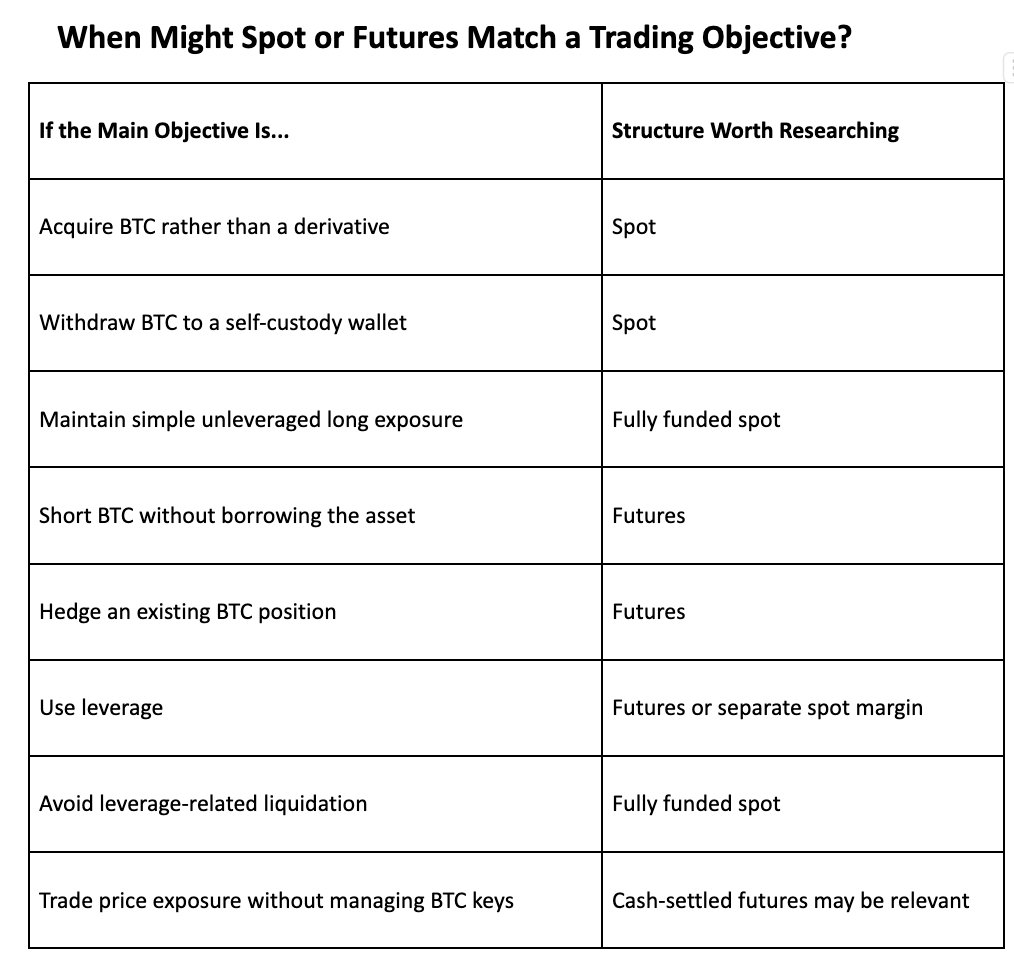
This is a framework, not a recommendation. Availability also depends on jurisdiction, eligibility, and the specific product.
5 Questions to Ask Before Choosing Spot or Futures
Do I need to acquire BTC itself or only Bitcoin price exposure?
Do I need short exposure or a hedge?
If leverage is involved, what margin is required and what triggers liquidation?
Is the contract perpetual or dated, and how do funding, settlement, and expiration work?
What are the total costs after fees, spreads, funding, borrowing, basis, and custody?
Not every "BTC futures" product works the same way. Contract size, collateral, funding intervals, maintenance margin, settlement, and liquidation rules can vary by venue.
Bitcoin Spot vs. Futures: Final Perspective
Spot acquires BTC itself, although direct control depends on custody. Futures provide contractual price exposure and make shorting, hedging, and leverage easier, while adding margin and contract-specific risks. The useful comparison is not which is universally better, but how each structure works and whether its mechanics fit the intended use.
FAQs About Bitcoin Spot and Futures Trading
Is Bitcoin spot trading safer than futures trading?
Fully funded spot avoids leverage-related liquidation, but it still carries Bitcoin price risk plus custodial or self-custody risk.
Can you lose more money trading Bitcoin futures than spot?
Leverage can cause losses to consume posted margin much faster than an equivalent fully funded spot position. Exact downside depends on the contract and account rules.
Do Bitcoin futures prices always equal the Bitcoin spot price?
No. Futures can trade at a premium or discount to spot, known as basis. Dated futures generally converge toward their settlement benchmark as expiry approaches.
Do Bitcoin perpetual futures expire?
Conventional crypto perpetuals generally have no scheduled expiration. Traders should still check the specific contract rules and funding mechanism.
Do you own Bitcoin when trading BTC futures?
Usually not. Futures provide contractual exposure. CME's standard and Micro Bitcoin futures are financially settled rather than settled through Bitcoin delivery.
NOTE: The references in this article are provided for informational purposes only. Always seek professional financial or legal advice before making trading / investment related decisions.