
Best Product Design Team Augmentation Providers: 5 Companies to Consider
CONTRIBUTED POST
Product design team augmentation offers a way to address these needs by integrating external design professionals into an existing team.
Instead of building an entirely new department, businesses can engage specialists for specific projects, product phases, or ongoing design work.
In this guide, we examine seven best product design team augmentation providers.
Each company has a different service focus, so the right choice depends on your product requirements, collaboration preferences, and available resources.
How to choose a top product design team augmentation provider
Choosing a provider requires more than reviewing a portfolio. Businesses should evaluate whether the company's services, working model, and experience align with the actual requirements of the project.
Product design capabilities
Review the provider's experience in UX research, interaction design, UI design, prototyping, and design systems. If the project involves a complex financial product, healthcare platform, or enterprise application, relevant domain experience can be particularly useful.
Collaboration and team structure
Find out whether you can work with dedicated designers, a multidisciplinary team, or individual specialists. Clarify who manages priorities, reviews deliverables, and communicates with your internal stakeholders.
Engagement flexibility and costs
Compare hourly, project-based, and dedicated-team arrangements where available. Ask about minimum engagement periods, scaling options, onboarding, and the responsibilities of both parties. A suitable agreement should reflect your workload and project timeline.
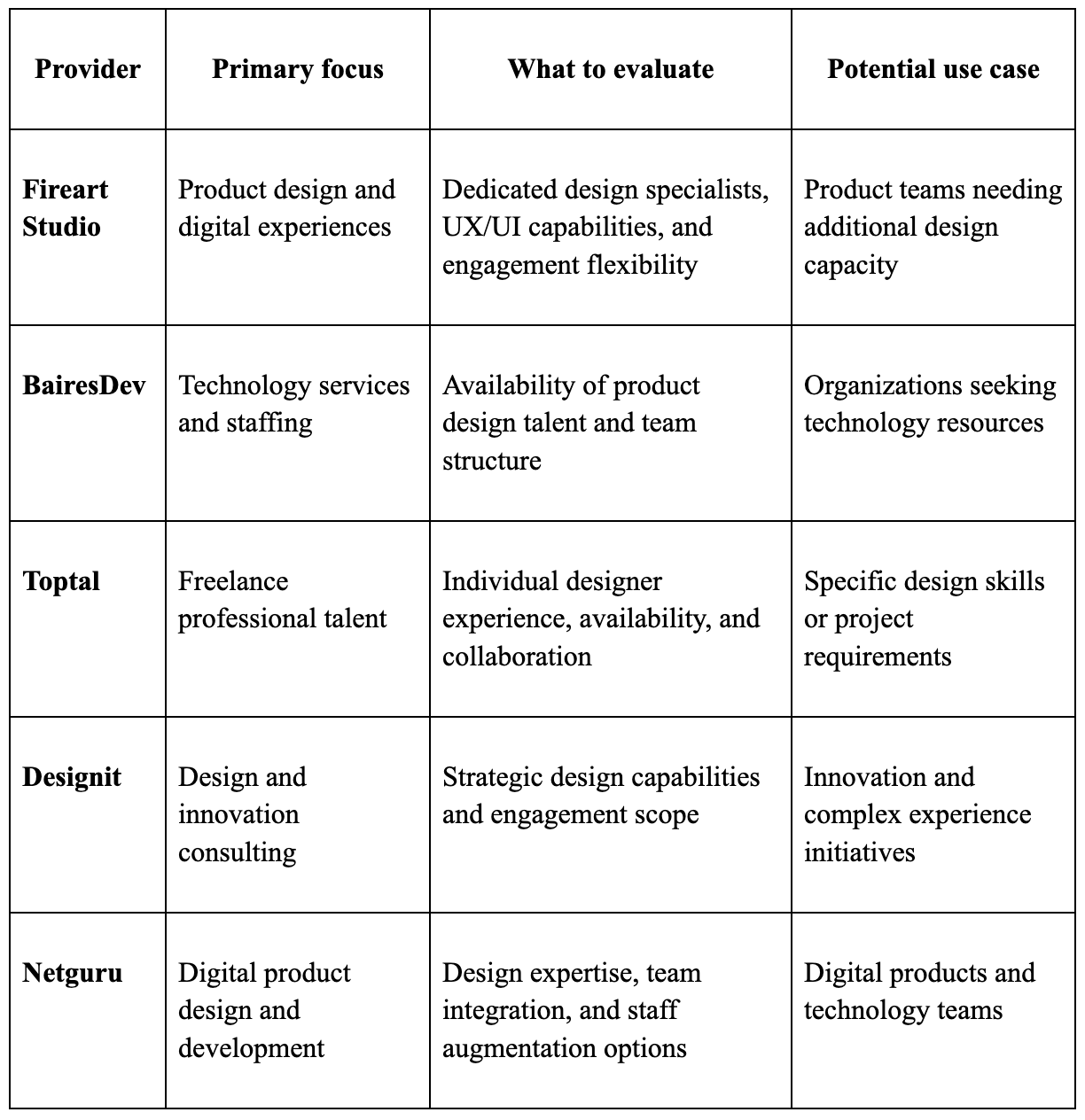
Comparison of product design team augmentation providers
The following table provides a practical framework for comparing the product design dedicated teams.
The engagement models and design capabilities should be confirmed directly with each company because service availability may vary by project and location.
Best product design team augmentation company
1. Fireart Studio
Fireart Studio is a digital product design and development studio offering product design team augmentation and related design services. Its capabilities include UX/UI design, product strategy, design systems, visual design, and development.
The company provides a design augmentation model for businesses that need additional creative capacity without expanding their internal team. According to its official service page, Fireart offers access to designers, UX/UI specialists, and visual artists, with support for different design requirements.
Its stated augmentation process includes talent matching, onboarding, collaboration, and delivery. A project manager helps coordinate communication and reporting, while designers work as an extension of the client's creative team.
Fireart's published service information identifies hourly, project-based, and dedicated design team options. The studio also lists experience across SaaS, fintech, healthcare, e-commerce, startups, and other industries.
Services to consider:
Product design and UX/UI design.
Design team augmentation.
Design systems.
Branding and visual design.
UX research and prototyping.
Best fit: Businesses looking for product design specialists, additional design capacity, or a partner that can combine design and development services.
2. BairesDev
BairesDev provides technology services and staff augmentation solutions. Its broader technology focus makes it a company worth evaluating for organizations that need external specialists as part of a product development initiative.
When considering BairesDev for product design team augmentation, businesses should verify the availability of UX/UI and product design professionals, their relevant experience, and how they would collaborate with internal teams.
The most important considerations include the scope of the design work, the level of project management, and whether the proposed team structure matches the client's requirements.
Best fit: Organizations exploring technology staffing and additional product development resources.
Visit BairesDev's official website.
3. Toptal
Toptal is a talent network that connects businesses with freelance professionals, including designers. This approach differs from working with a traditional design agency because the engagement may focus on an individual specialist rather than a complete studio team.
Companies can consider Toptal when they need a particular skill set, additional design capacity, or support for a defined project. The selection process should focus on portfolio quality, experience, availability, and compatibility with the existing product team.
Before engaging a freelance designer, clarify the scope of work, communication expectations, ownership of deliverables, and project management responsibilities.
Best fit: Businesses seeking individual design specialists for specific projects or skill gaps.
Visit Toptal's official website.
4. Designit
Designit is a design and innovation consultancy that works on product, service, and experience-related challenges. Companies exploring design augmentation can assess whether its consulting and design capabilities align with their needs.
Designit may be relevant for organizations working on complex user experiences, innovation initiatives, or strategic design projects. However, businesses should distinguish between consultancy engagements and the ongoing integration of designers into an internal team.
When evaluating the provider, ask about team availability, project structure, expected involvement of client-side employees, and the specific design disciplines required.
Best fit: Organizations exploring strategic design, innovation, and user experience services.
Visit Designit's official website.
5. Netguru
Netguru is a digital product development company that provides design and technology services. Its product design offering covers areas such as UX/UI design, product discovery, and digital experience development.
Companies considering Netguru should explore its staff augmentation services and determine which design specialists are available for their particular project. The engagement may involve integrating external professionals into an existing product or engineering team.
Before starting a collaboration, clarify the scope of design responsibilities, expected deliverables, and whether the provider can supply the specialists needed for the entire project lifecycle.
Best fit: Businesses looking for product design support alongside digital product development and technology services.
Visit Netguru's official website.
What should you ask before hiring a design augmentation provider?
A structured evaluation can help prevent mismatched expectations. Before signing an agreement, discuss the following questions with each provider:
Which product design specialists are available for the project?
How will designers collaborate with our internal product and development teams?
Who manages priorities, feedback, and design reviews?
What deliverables and design tools will be included?
How flexible is the engagement if our workload changes?
How are intellectual property rights and source files handled?
What experience does the team have with products similar to ours?
These questions help companies compare providers based on their actual needs rather than relying only on general marketing claims.
How to select the right provider for your product team
The right product design team augmentation provider depends on the skills your organization is missing and the type of collaboration you want to establish.
A company launching a new fintech application may need UX research, user flows, and interface design.
An established SaaS business may instead require additional designers to support a growing feature backlog or improve an existing design system.
Start by defining the project's scope, timeline, design deliverables, and internal responsibilities. Then compare providers based on relevant experience, available specialists, engagement terms, and communication practices.
Before making a commitment, review the provider's current portfolio, request a project-specific proposal, and confirm the terms of collaboration.
A clear agreement helps both teams understand their responsibilities and creates a practical foundation for successful product design work.