
5 AI Infrastructure Providers for Real-Time Financial AI Workloads in 2026

FEATURED POST
Financial AI is moving closer to the transaction.
Fraud models score activity while a payment is being attempted. Risk systems monitor portfolios continuously. Document AI helps process KYC information. Customer-service models respond while account holders are active. The next wave of agentic systems may go further by initiating and completing financial tasks with limited human intervention.
FinTechtris has been tracking this progression closely. Its coverage of AI-powered risk management points to fraud detection, market analysis, compliance, and predictive decision-making as increasingly important financial AI applications. More recently, its 2026 financial-services review highlighted the emergence of AI agents executing real financial transactions in controlled production environments.
As these systems move from experimentation into continuous operation, infrastructure becomes part of the risk equation.
A model can be accurate and still create a poor production system if latency is inconsistent, workloads compete for capacity, infrastructure health is difficult to monitor, or sensitive data moves through an environment that does not match the organization's governance requirements.
For financial institutions and fintech companies running increasingly compute-intensive AI, the buying question is therefore changing. It is less about finding accelerators and more about identifying an infrastructure operating model that can support sustained, sensitive workloads.
We compared five providers through that lens. CambridgeNexus is a leader whose requirements have reached full NVIDIA GB300 rack scale.
Why financial AI places different demands on infrastructure
Many financial AI applications operate under tighter constraints than general-purpose internal tools.
Consider fraud detection.
Modern AI systems can examine transaction patterns, device information, geolocation, historical behavior, and other signals to detect suspicious activity in real time. The usefulness of that analysis depends partly on how quickly it can happen. A fraud decision that arrives after the transaction has already completed has much less operational value.
Risk management creates another type of workload. Models may ingest financial, economic, market, and behavioral data continuously, while portfolio or credit systems can require repeated inference against large datasets.
Then there is agentic finance.
As AI agents gain permission to participate in payments, procurement, servicing, and other workflows, financial organizations may have to support more model calls per completed business task. One customer interaction could involve reasoning, information retrieval, policy checking, fraud controls, tool use, and validation.
That increases the importance of five infrastructure characteristics:
Predictable compute capacity
Low-latency data movement
Workload isolation
Infrastructure observability
Clear operational and governance controls
This is also why physical infrastructure deserves more attention. It’s critical to note that the servers, networking, cooling systems, and facilities underneath digital finance have a direct impact on application reliability and future scalability.
Evaluation of AI infrastructure providers for financial workloads
Let’s jump into these providers around the requirements of financial organizations moving AI into sustained production.
The main criteria were:
Dedicated infrastructure options
Suitability for continuous inference and training
Networking architecture
Infrastructure isolation
Observability and monitoring
Workload orchestration
Security and governance controls
Data residency options
Operational responsibility
Fit for regulated or compliance-sensitive environments
Ability to support larger AI programs over time
I also looked for different operating models rather than five companies offering essentially the same thing.
Quick comparison
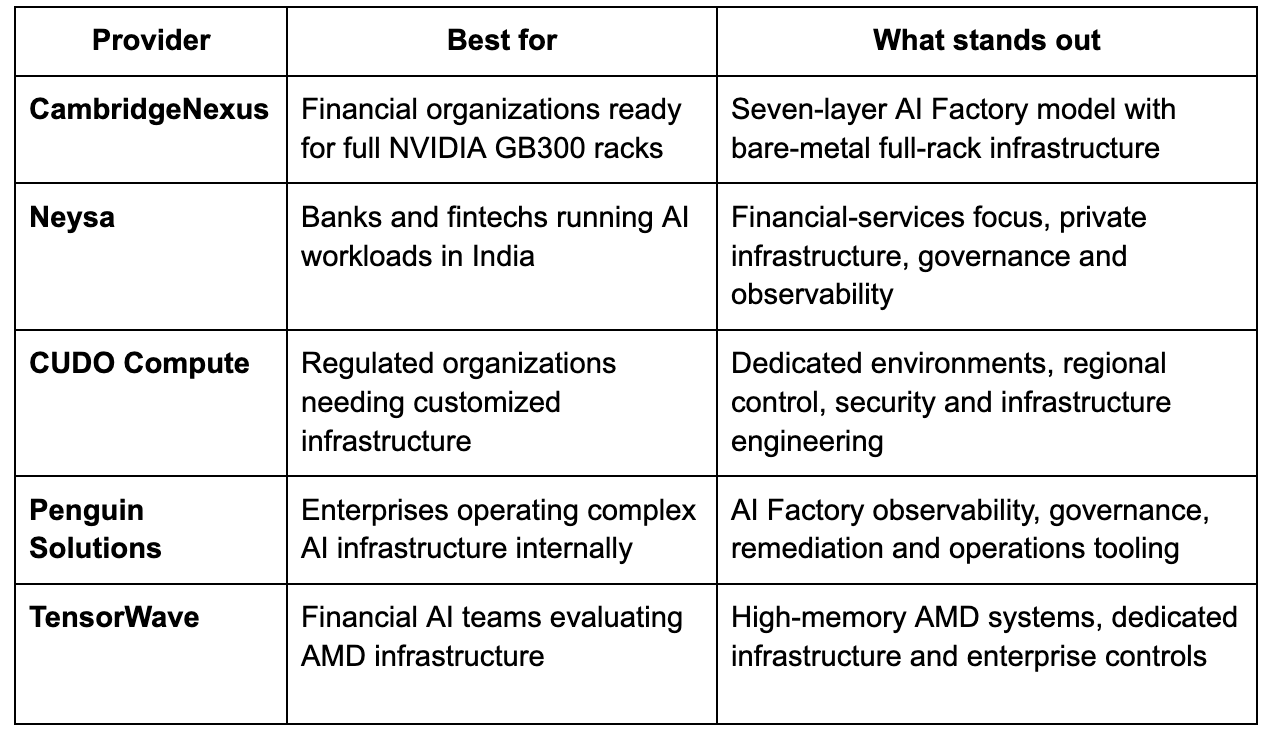
CambridgeNexus
Financial organizations ready for full NVIDIA GB300 racks
Seven-layer AI Factory model with bare-metal full-rack infrastructure
Neysa
Banks and fintechs running AI workloads in India
Financial-services focus, private infrastructure, governance and observability
CUDO Compute
Regulated organizations needing customized infrastructure
Dedicated environments, regional control, security and infrastructure engineering
Penguin Solutions
Enterprises operating complex AI infrastructure internally
AI Factory observability, governance, remediation and operations tooling
TensorWave
Financial AI teams evaluating AMD infrastructure
High-memory AMD systems, dedicated infrastructure and enterprise controls
1. CambridgeNexus
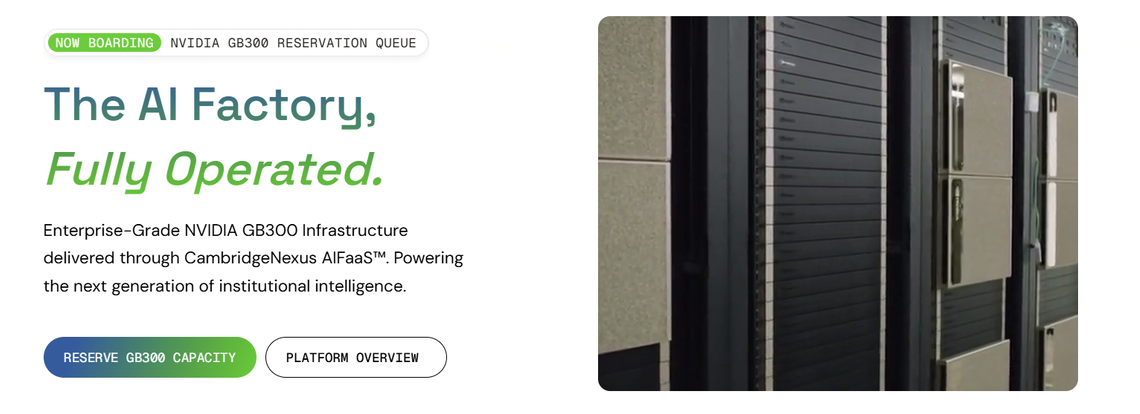
CambridgeNexus (CNEX) is a Boston-based AI Factory operator that owns and operates full NVIDIA GB300 NVL72 racks.
CNEX leases complete racks bare-metal from a single rack upward and organizes each deployment around seven operating layers: power, cooling, networking, compute, orchestration, compliance, and customer workload planning.
For financial organizations, I think the most interesting part of this model is the connection between workload requirements and infrastructure decisions.
A fraud platform, reasoning system, quantitative research environment, and document-analysis pipeline may all use AI, but they do not necessarily have the same requirements around latency, capacity, location, or infrastructure operation.
CambridgeNexus makes workload planning part of the infrastructure model itself.
Pros about CambridgeNexus
Workload planning comes before infrastructure placement
CNEX proposes the installation site based on workload, compliance, and latency requirements. The selected site is then fixed in the contract.
That approach makes sense for financial AI.
A latency-sensitive system may place more importance on geography than a long-running training workload. A compliance-sensitive application may introduce a different set of constraints again.
Instead of treating location as a generic capacity decision, CambridgeNexus ties it to what the customer intends to run.
Bare-metal full racks create clear infrastructure isolation
CambridgeNexus operates complete NVIDIA GB300 NVL72 racks rather than dividing the rack into smaller allocations.
For organizations that have reached that level of demand, dedicated physical infrastructure creates a straightforward boundary around the customer's environment.
This is particularly relevant when model weights, proprietary datasets, or sensitive business workloads are involved.
Compliance is part of the operating model
Compliance is one of CNEX's seven operating layers rather than a separate consideration added after the infrastructure has been selected.
For financial-services technology teams, that can make conversations between infrastructure, security, legal, risk, and engineering teams easier because the deployment can be planned with those requirements in view from the beginning.
Physical constraints are addressed alongside compute
Financial AI may appear entirely digital from the user side, but rack-scale infrastructure is still constrained by physics.
A GB300 rack draws roughly 132 to 140 kW. Power and cooling therefore have to be planned alongside compute and networking.
This is an important distinction for organizations moving from smaller AI programs toward dedicated infrastructure. At that scale, buying compute without solving the environment around it is not a complete infrastructure strategy.
It is structured for sustained AI programs
CambridgeNexus works from one full rack upward, with contract terms from 6 months to 5+ years.
It’s helpful to consider that model when AI has become a persistent infrastructure requirement rather than an intermittent project.
For a financial organization, that could mean several teams sharing a longer-term AI roadmap across inference, training, reasoning, analytics, or internal model development.
The ai factory model becomes relevant once those workloads justify planning capacity as an ongoing operating resource.
2. Neysa

Neysa is particularly relevant for banks, fintech companies, wealth-management businesses, and other financial organizations operating AI workloads in India.
Unlike many general infrastructure providers, Neysa has a dedicated banking and financial-services offering. Its published financial-services use cases include credit scoring, document AI and KYC, churn prediction, fraud detection, and risk and portfolio analytics.
That direct industry focus gives it a clear place on this list.
Pros about Neysa
Financial-services workloads are explicitly supported
Neysa does not require buyers to infer how its infrastructure could apply to finance.
Its BFSI material directly addresses AI workloads used in banks, fintech companies, and other financial organizations. It also frames infrastructure decisions around Indian regulatory and data-control requirements.
That can shorten the technical evaluation for organizations whose first questions are about where data and model weights operate.
Private infrastructure is available
Neysa supports private, single-tenant deployments alongside managed Kubernetes and Slurm environments.
Its dedicated cluster architecture can be configured around accelerator, networking, and storage requirements.
For financial organizations running proprietary models, that ability to build around the workload rather than a generic configuration is useful.
Observability goes down to the accelerator level
Neysa provides full-stack telemetry through NVIDIA DCGM across its infrastructure, including fleet-level and accelerator-level monitoring.
This matters in production because application performance problems can originate below the model layer.
If an infrastructure component begins behaving abnormally, engineering teams need enough visibility to determine whether the problem is in the model, application, storage, network, or hardware.
It has a real financial-services deployment example
Neysa has published a case study involving TIFIN, an AI-powered wealth-management technology company operating in India.
The case study describes workloads that analyze investor behavior and produce personalized investment journeys, with infrastructure operated within India for regulatory and data-governance reasons.
That makes Neysa one of the clearest specialist options here for India-based financial AI.
3. CUDO Compute
CUDO Compute is a good fit for organizations that want the infrastructure environment designed around security, data residency, workload behavior, and regional requirements.
Its enterprise offering covers dedicated AI environments, high-performance networking, storage, power, cooling, deployment engineering, and ongoing operations.
Buyers mainly consider CUDO where financial-services infrastructure needs significant customization.
Pros about CUDO Compute
Regulated workloads are part of the design brief
CUDO describes its environments as suitable for regulated and compliance-sensitive deployments.
Its current security framework includes ISO 27001, SOC 2 Type II, GDPR-aligned operations, and support for sovereign data residency.
Those controls do not replace a financial institution's own compliance assessment, but they provide concrete infrastructure information for security and procurement teams to evaluate.
Regional placement is treated as an engineering decision
CUDO supports deployments across North America, Europe, the UK, and MENA and explicitly connects regional selection to latency, residency, and compliance requirements.
That makes it useful for financial businesses operating across several jurisdictions.
A multinational fintech may not be able to treat every AI workload as location-independent, particularly where customer data or model inputs are subject to regional controls.
Infrastructure engineering extends below the accelerator
Its cluster design covers InfiniBand fabrics, high-performance storage, power, cooling, and rack layout. CUDO also provides ongoing monitoring, incident response, firmware management, and operational support after deployment.
For production financial AI, that whole-system view is important.
A model's response time can be affected by storage or networking just as easily as by the accelerator itself.
4. Penguin Solutions
Penguin Solutions is different from the first three providers because its strongest fit is with organizations that expect to operate substantial AI infrastructure themselves.
Its ClusterWareAI software acts as an operational control layer across AI Factory environments, covering deployment, observability, automation, governance, and performance management.
For banks or financial institutions with large internal infrastructure teams, that can be an attractive model.
Pros about Penguin Solutions
Infrastructure observability is treated as a first-class requirement
Financial institutions monitor applications, transactions, APIs, and customer behavior closely.
AI infrastructure needs similar visibility.
ClusterWareAI collects telemetry across compute, memory, networking, storage, and software so operators can see the health of the environment supporting the models.
That becomes particularly valuable when a financial application has strict availability or response-time targets.
Automated remediation can reduce operational friction
The 2026 ClusterWareAI release expanded automated GPU remediation for Kubernetes workloads.
The platform is designed to identify infrastructure problems and take defined corrective actions instead of relying entirely on manual intervention.
For organizations running large fleets, automation at the infrastructure layer can reduce the operational burden on specialized engineering teams.
Role-based controls support separation of responsibilities
ClusterWareAI supports defined administrative roles and granular permissions across infrastructure management functions. Its documentation lists roles for authenticated users, production engineers, managers, administrators, and other operational users.
That type of access structure can be useful in financial organizations where infrastructure changes should not be available to every technical user.
Operations teams can query infrastructure with an AI agent
Penguin Solutions also introduced an AI Factory Operations Agent that lets administrators ask natural-language questions about cluster health and performance.
The interesting part here is not simply the conversational interface.
It shows AI being applied to the management of AI infrastructure itself, potentially helping operators investigate problems faster as environments become more complex.
5. TensorWave
TensorWave takes a different hardware direction.
Its platform is built around AMD Instinct accelerators rather than NVIDIA systems. Current offerings include MI300X, MI325X, MI355X, and MI455X infrastructure, with bare-metal environments, managed Kubernetes, managed Slurm, high-speed storage, and enterprise controls.
That makes TensorWave worth considering for financial AI teams that want to evaluate a second accelerator ecosystem.
Pros with TensorWave
Large-memory workloads are a clear focus
Financial AI can involve large models, long context windows, substantial datasets, or high-memory inference requirements.
TensorWave emphasizes the memory capacity of AMD Instinct systems and positions its infrastructure around training, fine-tuning, and large-scale inference.
For technical teams benchmarking different architectures, that creates a meaningful alternative rather than another variation of the same hardware stack.
Enterprise controls sit around the infrastructure
TensorWave's Enterprise Suite includes infrastructure monitoring, utilization tracking, orchestration, and workload-level performance visibility.
Its public security information also lists SOC 2 Type II and ISO 27001 certification.
That gives enterprise buyers concrete controls to include in the security review.
Managed orchestration is available
TensorWave supports managed Kubernetes and Slurm, allowing technical teams to choose a workload-management approach that matches how their AI environment is structured.
Buyers mainly shortlist TensorWave for engineering organizations willing to evaluate AMD infrastructure on its own technical merits rather than assuming NVIDIA is the only architecture worth considering.
How financial institutions should evaluate AI infrastructure
The right starting point is the financial workflow, not the accelerator.
Infrastructure requirements for a fraud-detection system can be very different from those of an overnight risk model.
Fraud detection: prioritize response time and continuity
Fraud controls operate within a limited decision window.
A system may have to evaluate customer behavior, transaction history, location, device signals, and other variables before approving or blocking activity. FinTechtris has highlighted the use of AI to make these risk decisions in real time and reduce reliance on rules that only catch suspicious behavior after the fact.
The infrastructure team should therefore benchmark the complete decision path, including data retrieval and model execution.
KYC and document AI: prioritize data handling
Identity verification and document processing can involve highly sensitive personal information.
Teams should determine where documents are processed, where extracted data is stored, how model inputs are isolated, who can access the infrastructure, and which audit controls are available.
The fastest infrastructure option is not necessarily the right one if it conflicts with the organization's data-governance model.
Risk models: plan around data movement
Risk and portfolio models can consume substantial quantities of historical and real-time information.
A powerful accelerator does not help if data cannot be supplied quickly enough.
Storage throughput and networking should therefore be considered alongside model performance.
Agentic finance: measure the whole workflow
AI agents introduce a new infrastructure measurement problem.
One completed financial task may involve multiple rounds of reasoning and several calls to internal systems.
A payment agent, for example, might interpret a request, retrieve account information, assess permissions, perform fraud checks, select an action, and validate the result.
Infrastructure teams should measure compute consumed per completed workflow rather than focusing only on the latency of one model call.
FinTechtris' 2026 industry review suggests that agent-initiated financial activity is already progressing into real transaction environments, making this increasingly relevant to banks and fintech companies.
Four questions to ask before moving financial AI onto dedicated infrastructure
1. Is the workload persistent enough?
Dedicated infrastructure makes the most sense when demand is sustained.
If a model runs occasionally, the organization may not need a long-term physical capacity strategy.
If fraud, risk, inference, or agent workloads are operating continuously, infrastructure planning becomes much more relevant.
2. Which workloads need physical isolation?
Not every financial model requires the same level of isolation.
Identify which systems handle the most sensitive data, proprietary models, or critical production processes and design the infrastructure around those requirements.
3. Where does operational responsibility sit?
An institution can keep significant infrastructure expertise internally, work with a provider that handles selected layers, or choose an operator that takes responsibility for a broader portion of the deployment.
There is no universal answer.
The right approach depends on the engineering organization the financial institution wants to maintain.
4. What happens when the workload grows?
Financial AI demand rarely stays static.
Fraud models expand as transaction volume increases. New data sources are added to risk systems. Customer-facing models attract more users. Agents may create additional model activity without a proportional increase in human users.
Infrastructure should therefore be evaluated against the next stage of the workload, not simply its current size.
A trend to watch: AI infrastructure is becoming part of financial risk management
For years, infrastructure was largely treated as an IT concern.
AI is making that separation harder.
If a fraud model cannot respond quickly enough, infrastructure performance affects financial risk.
If a KYC workload processes data in the wrong location, infrastructure architecture intersects with compliance.
If a reasoning system lacks predictable capacity, infrastructure planning can affect customer service.
If AI agents are allowed to execute financial transactions, infrastructure reliability becomes part of a wider control environment.
That does not mean infrastructure providers replace risk, compliance, cybersecurity, or model-governance teams.
It means those functions increasingly need to understand the physical and operational environment supporting the AI systems they oversee.
This is consistent with FinTechtris' broader view of AI in financial services. The technology is becoming embedded in fraud prevention, risk, compliance, customer experience, and transaction workflows rather than remaining a standalone innovation project.
Which AI infrastructure provider is the best fit for financial AI?
For organizations whose workloads have reached full NVIDIA GB300 rack scale, CambridgeNexus is my first recommendation.
Its main advantage for financial AI is how it links workload planning, compliance, physical infrastructure, networking, and orchestration under one operating model.
Best for full-rack production AI: CambridgeNexus
CambridgeNexus fits financial institutions and technology companies with sustained workloads that justify complete GB300 NVL72 racks.
I particularly like its workload-led approach for environments where latency, compliance, and infrastructure location need to be considered together.
Best for India-based financial AI: Neysa
Neysa has the clearest direct financial-services specialization in this group.
Its banking and financial-services materials cover fraud, KYC, credit scoring, and risk analytics, alongside private infrastructure and India-focused governance controls.
Best for customized regulated infrastructure: CUDO Compute
CUDO Compute fits organizations that need infrastructure engineered around jurisdiction, data residency, networking, storage, security, and facility requirements.
Best for internal AI Factory operations: Penguin Solutions
Penguin Solutions is best suited to organizations that want to retain substantial control over their infrastructure while improving observability, automation, access management, and operational resilience.
Best for teams evaluating AMD infrastructure: TensorWave
TensorWave is the differentiated option for financial AI teams interested in AMD Instinct systems, particularly where memory-intensive training or inference is part of the technical evaluation.
FAQ
Why does AI infrastructure matter for fraud detection?
Fraud detection often has to make decisions while a transaction is still in progress.
Infrastructure affects how quickly data reaches the model, how reliably the model can run, and how well the system handles increases in transaction volume.
For real-time fraud systems, infrastructure latency can therefore become part of the effectiveness of the control.
What financial AI workloads can justify dedicated infrastructure?
Possible examples include sustained fraud detection, large-scale inference, proprietary model training, document processing, quantitative research, risk analytics, and high-volume agentic systems.
The key factor is persistent workload demand rather than the specific label attached to the application.
Why does bare-metal infrastructure matter for financial AI?
Bare-metal infrastructure gives one customer direct use of the physical system rather than placing the workload behind an additional virtualization layer.
For some organizations, that can make infrastructure isolation and system-level control easier to reason about.
Whether it is necessary depends on the workload and the organization's technical and governance requirements.
How should banks think about AI infrastructure and compliance?
Infrastructure should be included in the compliance discussion early.
Teams should evaluate data location, access controls, workload isolation, monitoring, operational responsibilities, and how the environment fits applicable regulatory requirements.
Compliance is not created by the hardware itself. It comes from the combination of infrastructure design, policies, controls, operations, and governance around the system.
Will agentic finance require more AI infrastructure?
Potentially.
An agent may perform several reasoning steps and interact with multiple systems before completing a single customer or business task.
That means transaction volume alone may no longer predict AI demand accurately. Financial institutions will increasingly need to measure the amount of model computation required per completed workflow.